
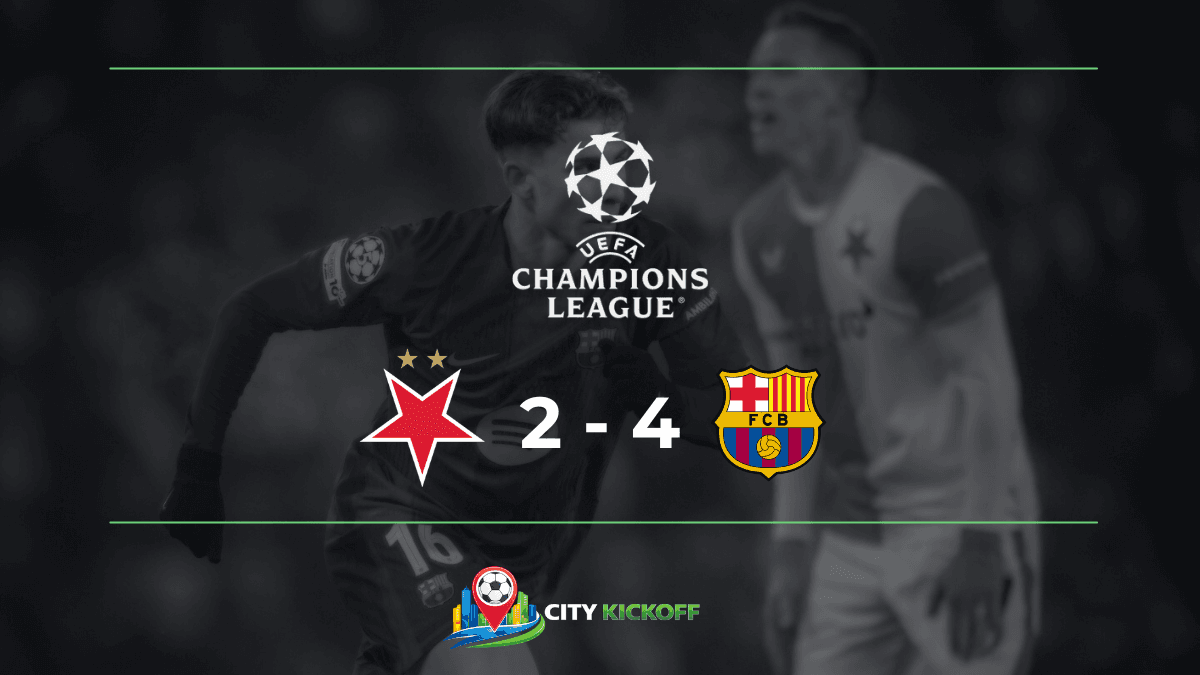
Barcelona came from behind to beat Slavia Praha 4–2 with a Fermín López brace and Olmo’s spark.
Prague in January has a way of stripping football back to essentials: touch, nerve, breath. At Eden Arena on Wednesday night, with the temperature sitting below freezing, Barcelona looked like a side trying to play with gloves on — until the game demanded they take them off.
They did, eventually, and the scoreline says “2–4” in Barcelona’s favour. But it wasn’t the tidy European away win that a heavyweight imagines when the draw is made. It was messy, cold, and uncomfortable — and that’s precisely why it mattered.
Barcelona’s league-phase campaign still has edge to it, still needs points and goal difference, and still can’t afford an off-night. In that sense, this was less a performance to admire than a result to bank.
A night of corners, shoulders, and the one player who kept finding space
Slavia Praha 2–4 Barcelona
UEFA Champions League, league phase — Wednesday, January 21, 2026
Eden Arena (Prague)
Slavia struck first, and they did it the way underdogs dream of doing it: by making a set-piece feel like a rehearsed ambush. A corner was worked across the box, Tomáš Holeš flicked it on, and Vasil Kušej forced it over the line with bodies converging at the far post. 1–0 after 10 minutes, and suddenly Barcelona had to play the match Slavia wanted.
Barcelona’s response, crucially, came from a midfielder arriving like a forward. Fermín López has that instinct — the knack of appearing where the pitch is briefly empty. His equaliser on 34 minutes was a sharp finish from inside the area, squeezed in at the near post, and it steadied Barcelona’s pulse. Eight minutes later, he did it again: this time from the edge of the box, picked out with precision into the bottom corner. In a half where Barcelona oscillated between control and vulnerability, López was the one constant.
And yet, they still went in level — because the same weakness that had opened the match came back to bite them. Under pressure defending another corner, Robert Lewandowski glanced the ball into his own net. Barcelona had turned the game, then handed it back.
Why Barcelona’s second half felt different
At 2–2, this had the shape of a night that can rot on you: frozen ground, a crowd sensing history, a favourite with one eye on bigger stages. But Barcelona’s second half was more purposeful — not just more possession, but more intent with it.
They pressed Slavia deeper, recycled the ball faster, and started to force second balls around the box. The chances came — and were missed — until the key swing arrived from the bench. Dani Olmo, introduced after Pedri was forced off with a muscular injury, changed the temperature of the match with one strike: a fierce effort from the edge of the box into the top corner on 64 minutes. It was the kind of goal that quiets a stadium not through silence, but through acceptance.
From there, Barcelona finally played like a team that understood the stakes. Lewandowski, who had lived a full storyline already — scorer at the wrong end, then redeemer-in-waiting — finished the job on 70 minutes. Marcus Rashford, another second-half substitute, tore down the left and delivered into the area; Lewandowski reacted quickest to poke it past Jindřich Staněk and put the night out of Slavia’s reach.
What the result means right now
Barcelona left Prague with three points and a 4–2 win that keeps them in the traffic jam around the automatic qualification places. The result lifted them to ninth in the league-phase standings on 13 points with one game remaining, part of a crowded chase for the top eight. Slavia, meanwhile, stayed near the bottom with just three points.
If you’re looking for a neat moral, it’s this: Barcelona can still overwhelm teams when they accelerate, but they are not currently built to sleepwalk through awkward nights. In Prague, the set-piece concessions and the self-inflicted equaliser were warning flares. The second-half control, the bench impact, and Fermín López’s decisiveness were the antidote.
The best Champions League sides don’t just win when it’s comfortable — they win when the air hurts your hands and the match keeps asking you questions. Barcelona didn’t answer all of them at Eden Arena. But they answered the one that mattered most.