
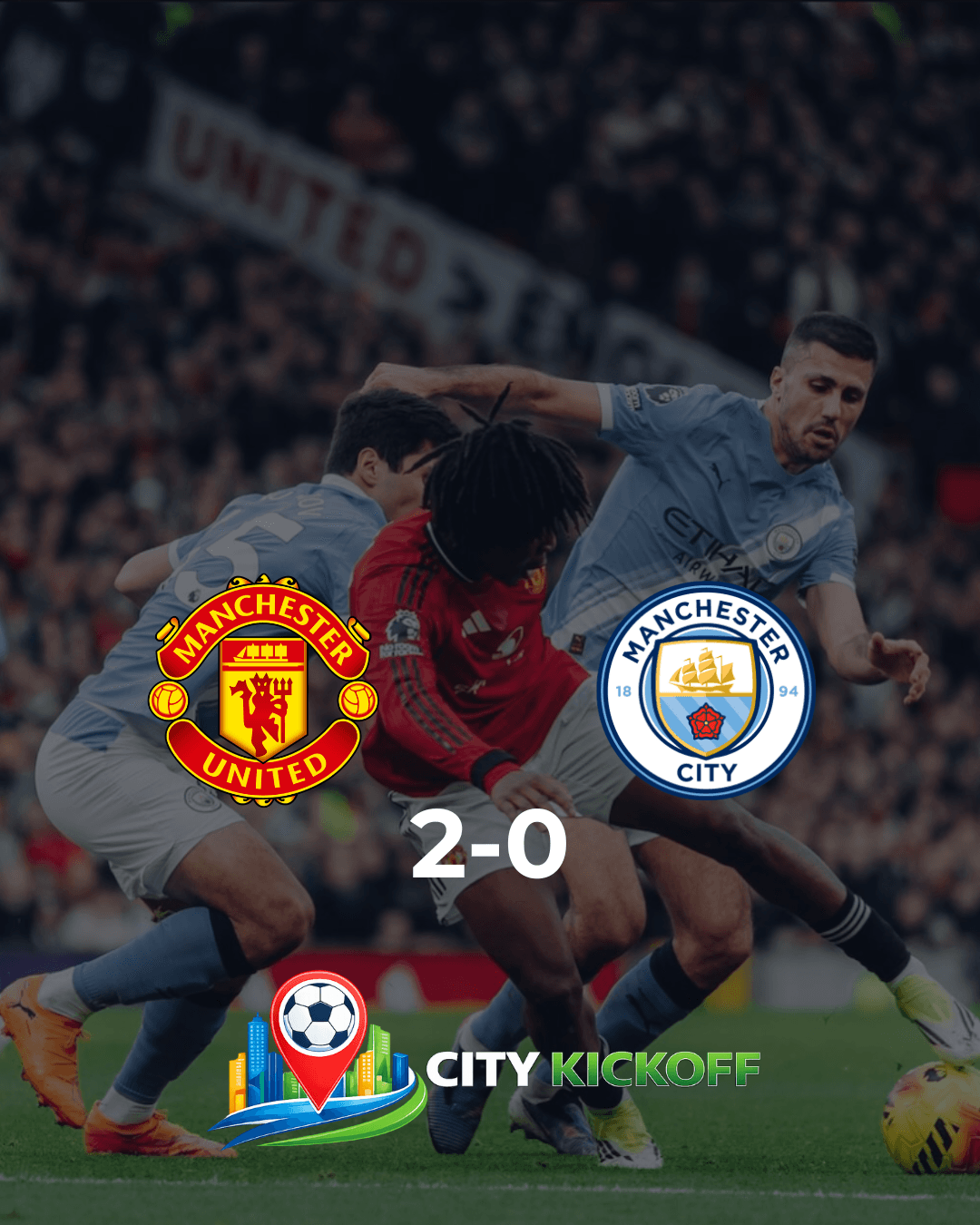
Manchester United stunned Manchester City in the Premier League , winning 2–0 at Old Trafford in a tactically compelling derby.
The sun dipped behind Old Trafford on 17 January 2026 as Manchester’s most enduring rivalry took centre stage. For a club whose season had been a patchwork of inconsistency, Manchester United produced one of their most meaningful performances of the 2025–26 Premier League campaign to date. Opposite them stood Manchester City, holders of continental aspirations and league momentum, but on this afternoon it was United who carried the narrative.
In a match long anticipated, tactical intrigue and derby intensity collided — and by full-time the roar from the Stretford End was not just about goals, but belief. By beating their neighbours 2–0, United delivered a result that felt both rare and significant in a campaign defined by transitions.
A Derby Defined by Purpose and Precision
From the outset the stakes were clear: United needed a statement, City sought to reaffirm their title credentials. Pep Guardiola’s side controlled the ball with a clinical 68 % possession, probing for openings with their customary incisiveness. Yet such control rarely translated into clear danger. Instead, it was United — disciplined, direct and unyielding — who found the margins that matter most in derby football.
When Bryan Mbeumo broke the deadlock in the 65th minute it was more than a goal — it was United’s tactical masterstroke realized. A quick transition, engineered by Bruno Fernandes’ arresting vision, exploited the spaces vacated by a City midfield that had been overrun. United’s counter-attack was swift, purposeful and ruthless: Mbeumo composed himself to slot beyond the outstretched glove of Donnarumma with all the calm of a striker who knows this moment matters.
The second, delivered by Patrick Dorgu in the 76th minute, wasn’t merely a cushion — it was tactical vindication. City’s high line invited pressure, United’s wide play stretched the pitch, and Dorgu’s finish from Matheus Cunha’s neat service showcased United’s clinical instincts.
Tactical Undercurrents: Structure Over Sentiment
United’s set-up under interim manager Michael Carrick strayed from sentimental loyalty and embraced pragmatic efficiency. Lining up in a structured 4-2-3-1, they oscillated between compact defending and explosive forward bursts. Casemiro and Mainoo anchored the midfield with disciplined positioning, freeing Fernandes to orchestrate with both urgency and creativity. When City pressed high, United’s pivot moved the ball with decisive clarity — a nuance that defined their attacking identity.
City, by contrast, suffered from an all-too familiar Premier League challenge: possession without penetration. Their 4-1-4-1 shape controlled territory but not tempo, and Erling Haaland — an ever-present threat — was shackled by United’s disciplined back line and a central midfield that denied him the service he thrives on. Despite dominating the ball, their attacking transitions lacked the incisive edge required to pierce this resolute United side.
Moments that Tilted the Balance
Two events encapsulated the derby’s arc. First, the offside-ruled goal for United in the first half — a strike from Bruno Fernandes that would have altered early momentum — reminded both sides how fine derby margins can be. Second was Diogo Dalot’s reckless challenge on Jérémy Doku, which many argued merited a red card but remained a yellow after VAR review. These flashpoints underscored the derby’s defining trait: emotion and impact in equal measure.
What This Result Means
This wasn’t merely a derby victory; it was a Premier League statement. For United, coming from a season of turbulence and managerial change, a home win against their most bitter rivals provides a psychological boost that transcends three points. For City, the result serves as a tactical probe that exposed vulnerabilities: dominance of possession is not dominance of narrative.
United’s climb up the table gains renewed purpose. City’s pursuit of silverware, by contrast, is momentarily reframed: excellence in performance must translate into ruthlessness in result.
In the theatre of English football, this derby will be remembered as the day United combined intent with execution — a result that reverberates not for what it was on paper, but for what it meant on the pitch.