
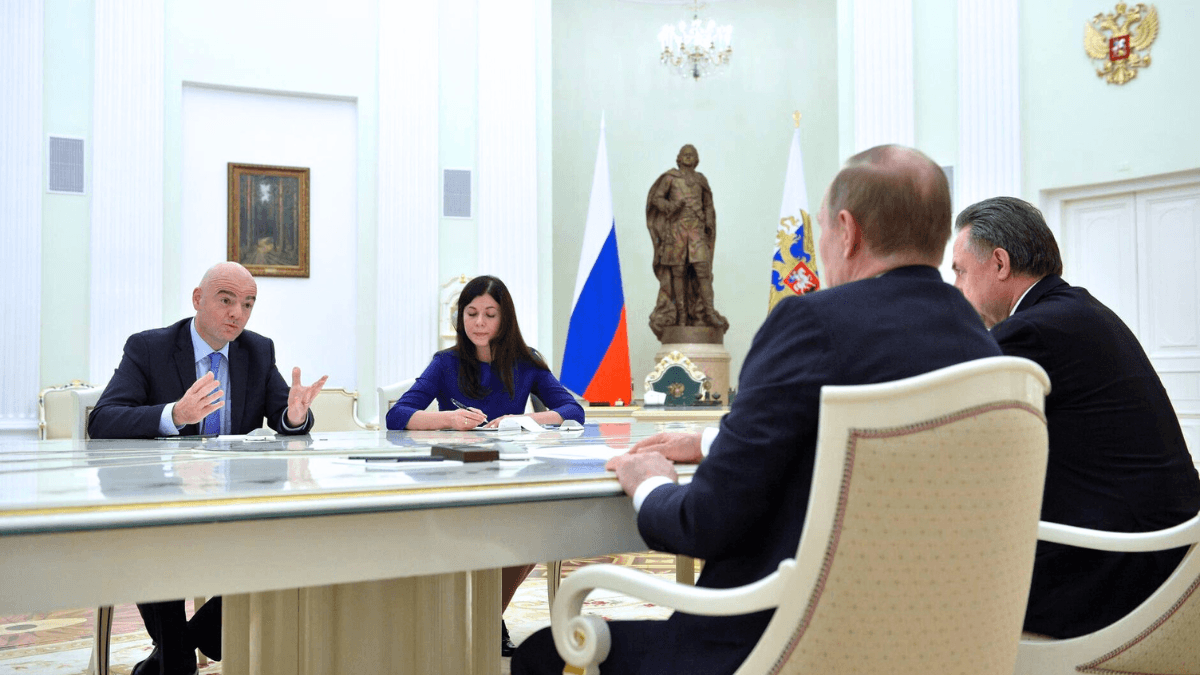
Kremlin.ru, CC BY 4.0 https://creativecommons.org/licenses/by/4.0, via Wikimedia Commons
Four years after Russia and Belarus were suspended from international football, the president of the FIFA, Gianni Infantino, has signaled that the organization is reconsidering the long-standing ban imposed following the 2022 invasion of Ukraine.
Speaking in a recent interview with Sky Sports, Infantino acknowledged that the sanctions may have failed to achieve their intended goals. According to the FIFA president, the exclusion has “not achieved anything” and has instead fueled “more frustration and hatred,” particularly among younger players.
A possible return through youth competitions
Infantino suggested that any potential reintegration would begin with youth categories rather than senior national teams or professional clubs. He emphasized that children should not bear the consequences of political decisions made by governments.
Allowing young players from Russia and Belarus to compete abroad, he argued, could serve as a bridge rather than a barrier. “Letting boys and girls play football in other parts of Europe can help more than isolation,” he said, adding that FIFA has a responsibility to protect the game’s unifying role.
Since early 2022, Russian and Belarusian national teams and clubs have been barred from FIFA and UEFA competitions, a decision that prevented Russia from taking part in the World Cup in Qatar, the European Championship, and the ongoing qualification process for the 2026 World Cup.
Moscow welcomes Infantino’s remarks
The comments were welcomed in Moscow. Kremlin spokesperson Dmitry Peskov described Infantino’s position as a positive step and reiterated Russia’s long-held view that sport should remain separate from politics.
Russian officials argue that the ban has infringed on the rights of players and supporters alike. The Russian national team has not played an official competitive match since late 2021, remaining sidelined from the international calendar.
Broader questions over political neutrality
Infantino’s remarks also reignited debate over how football’s governing bodies respond to global conflicts. When asked whether similar sanctions could be applied to Israel, the FIFA president rejected the idea, warning that banning countries for the actions of their political leaders would represent a “defeat” for the sport.
He reiterated that FIFA’s statutes should ensure that football remains a platform for unity rather than exclusion, a stance that has drawn both support and criticism across the international sporting community.
No final decision yet
Despite Infantino’s comments, no formal decision has been announced. Any move to lift or ease the ban would require consultation with FIFA’s member associations and coordination with UEFA, where opposition to the return of Russian teams remains strong.
For now, the debate marks a notable shift in tone from football’s global leadership. As the conflict in Ukraine continues, FIFA faces growing pressure to balance political realities with its stated mission of keeping the world’s most popular sport open and inclusive—especially for the next generation of players.