
War… and then Silence
In December 1914, just months after World War I began, Europe was already drowning in blood.
The Western Front in Belgium and France was a frozen battlefield of mud, barbed wire and death. British and German soldiers were positioned just 270 meters apart, separated by what was known as No Man’s Land.
And then, something impossible happened.
On Christmas Eve, German soldiers began singing “Stille Nacht” (Silent Night) from their trenches.
The British responded with their own carols.
Instead of gunfire, there was music.
Instead of artillery, there were voices.
And then came the words that changed everything:
“Tomorrow, you don’t shoot. We won’t shoot.”
🤝 The Truce in No Man’s Land
On December 25th, soldiers cautiously stepped into No Man’s Land.
No one fired.
They shook hands.
They buried their dead.
They exchanged chocolate, cigarettes, buttons, and small gifts sent from home.
For a brief moment, enemies became human again.
Many officers reluctantly allowed it. Others later tried to suppress it.
But history had already been written.
⚽ The Football Match That Shouldn’t Have Happened
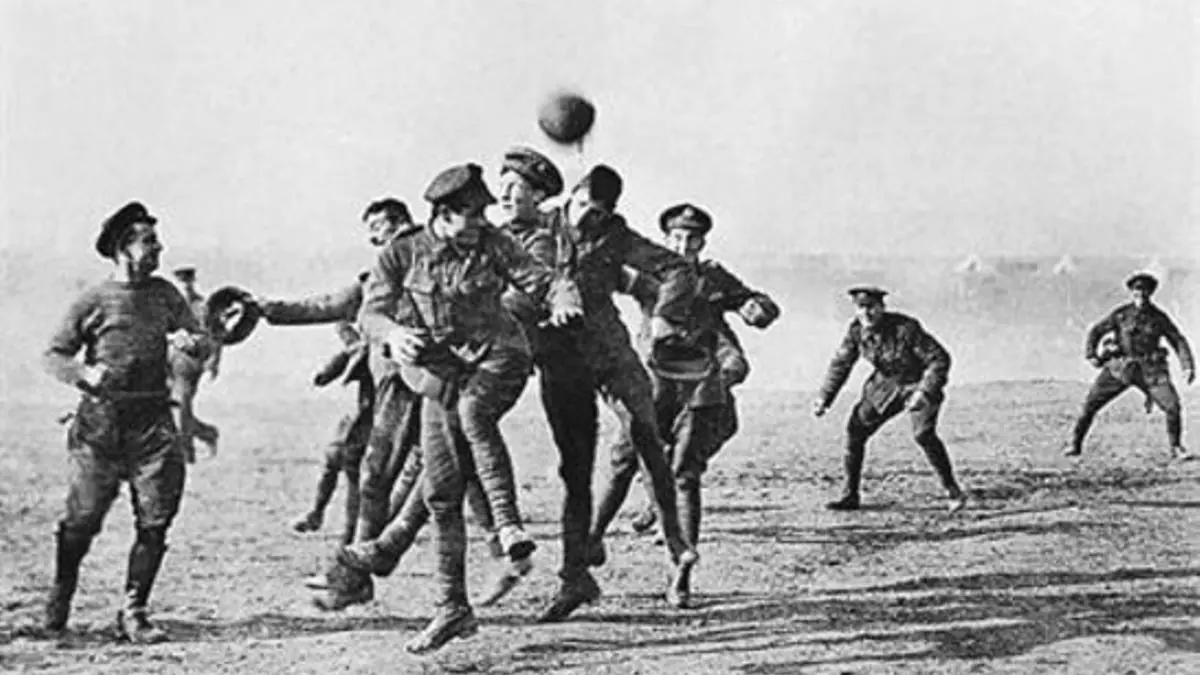
And then — a football appeared.
According to testimonies, a Scottish soldier brought the ball into No Man’s Land. Soon, German and British soldiers formed teams.
There were no proper goals.
No referee.
No official rules.
Helmets were used as posts.
The pitch was frozen.
The war was not.
But for about an hour… football won.
Some reports say Germany won 3-2.
Others say the result doesn’t matter.
Because the real victory wasn’t the scoreline.
It was humanity.
🎥 From History to Pop Culture
In 1983, Paul McCartney released Pipes of Peace, a music video recreating the truce and the football match.
In 2014, the centenary year, FIFA inaugurated a monument near Ypres, Belgium, commemorating what many call:
The most beautiful football match ever played.
❄️ Why It Still Matters
The war continued for four more devastating years.
Millions died.
There was never another Christmas like 1914.
But the letters and diaries of those soldiers tell us something powerful:
Even in the darkest moments, football can unite what politics divides.
And maybe that is why this remains one of the most extraordinary chapters in the history of the game.