
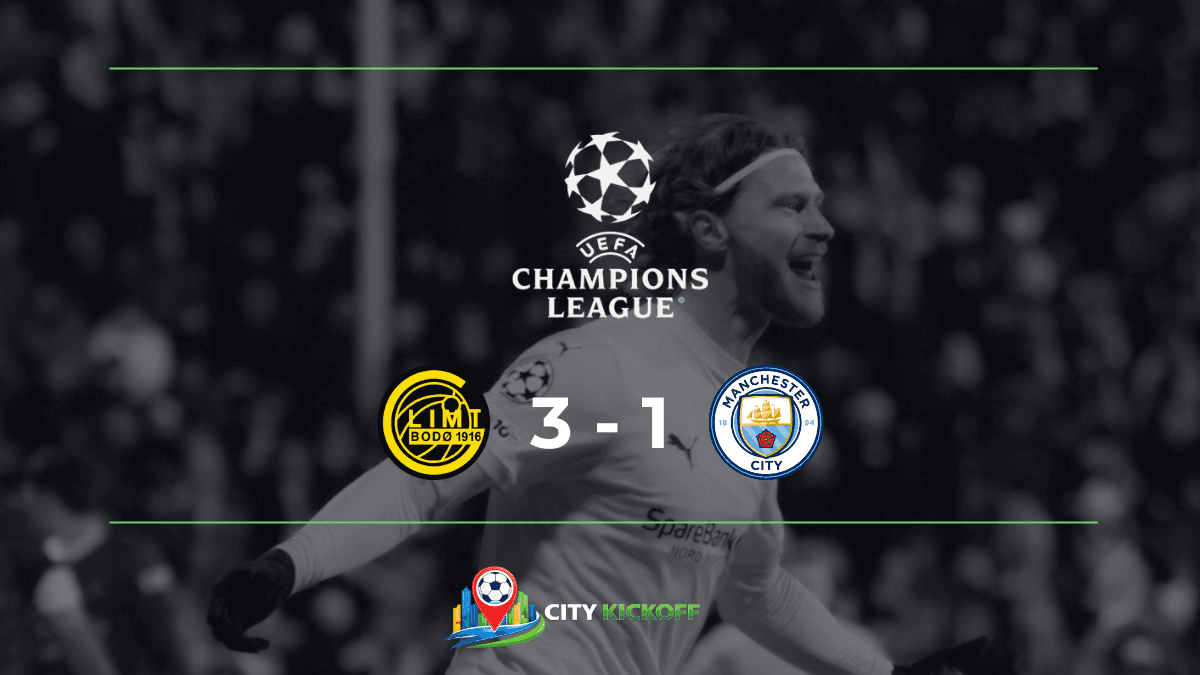
The Arctic wind howled around Aspmyra Stadion late into the night of January 20, 2026, but nothing matched the cold reality sinking into Pep Guardiola’s Manchester City. What promised to be a routine group-stage finale for the defending European champions dissolved into one of the competition’s most startling upsets in memory: a 3–1 defeat at the hands of Bodø/Glimt.
City arrived as heavy favourites, their continental pedigree dwarfing that of the Norwegian minnows. Yet this was not a grinding attritional loss — it was a tactical dismantling, sparked by intent, execution, and a red card that shifted the game’s balance irreversibly.
From the outset, Bodø/Glimt’s plan was obvious and brilliantly simple: absorb early pressure, strike with precision on the counter, and make the artificial turf and Arctic conditions an asset rather than an obstacle. Within the first 25 minutes they had done precisely that.
Kasper Høgh, a striker more used to making noise in Scandinavia than silencing European royalty, emerged as the early protagonist. Two goals in quick succession — at 22 and 24 minutes — were textbook counterattacks: vertical transitions that pulled City’s midfield out of shape and exposed inexperienced central defenders to Bodø’s pace.
City’s response was uncharacteristically flat. They dominated possession but lacked penetration, a theme that has crept into performances this season. Erling Haaland, often the focal point of City’s attacking rhythm, was peripheral; the ball never seemed to stick long enough in dangerous areas for him to assert himself consistently.
In the second half, Jens Petter Hauge’s finish extended the lead to 3–0 — a scoreline that, if honest to the chances and transitions of the first hour, felt deserved. When Rayan Cherki finally pulled one back with a well-struck attempt from outside the area, City briefly stirred.
But the moment that truly defined the night came not on the scoresheet but in the disciplinary book. Rodri, usually the metronomic anchor in midfield, was dismissed after receiving two yellow cards within 60 seconds — a reckless pair of challenges that not only reduced City to ten men but also drained whatever tactical confidence Guardiola’s side still retained.
From there, City’s shape dissolved. As the visitors pushed numbers forward trying to swing the momentum back, gaps appeared that Bodø/Glimt exploited with clinical discipline. The Norwegian side, now with real belief and a lead to protect, shifted between compact defending and rapid transition with a tactical clarity rarely seen from underdogs at this level.
Looking at the broader competition context, the loss is more than a single blemish — it jeopardises City’s pursuit of a top-eight spot in the league phase. With one group game remaining against Galatasaray at the Etihad, this result means there is no margin for error. A win is imperative if they are to avoid the playoff round or worse.
For Bodø/Glimt, the victory is seismic. Not just because it’s their first in the Champions League, but because it was earned through tactical intelligence and spirited execution against one of Europe’s technical elites. Nights like this are the heartbeat of the competition — where strategy, spirit, and circumstance collide to rewrite expectations.
City will return to Manchester to nurse bruised egos and recalibrate. But for one freezing night above the Arctic Circle, Bodø/Glimt wrote themselves into European folklore with a performance that was as inspiring as it was destructive to their illustrious opponents.