

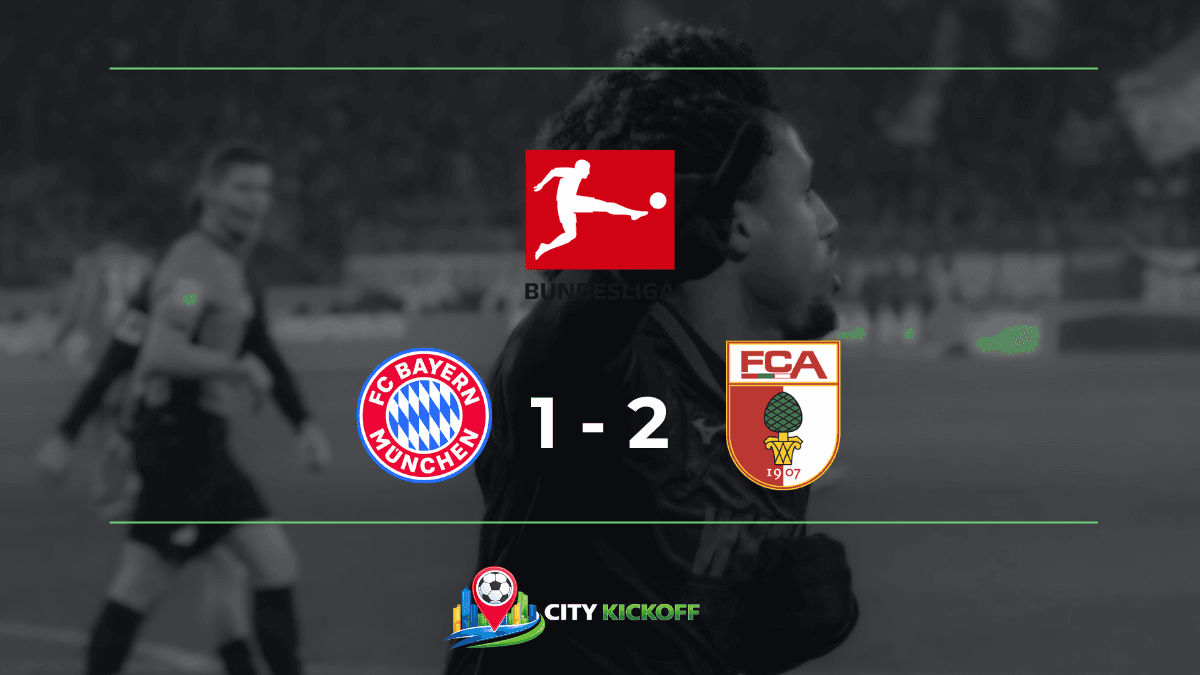
Augsburg stunned Bayern 2–1 at the Allianz. Ito scored first, Chaves equalised, Massengo struck late.
On January 24, 2026, the Allianz Arena slipped into an unfamiliar quiet. Not the stunned silence of a collapse, but something more unsettling — the moment when a match you believe is under control slowly turns against you. Bayern had territory, rhythm, and the early lead. What they didn’t have, by the end, was the result.
This was supposed to be routine. Instead, it became a reminder that dominance without decisiveness leaves room for doubt — and doubt invites punishment.
How the night unfolded
Bayern’s opener felt like confirmation rather than surprise. Hiroki Ito arrived at the right moment to make it 1–0, the type of goal that usually settles both nerves and narrative. Bayern settled into their familiar shape, pinning Augsburg back, circulating possession, compressing the pitch.
But the match never tilted fully out of Augsburg’s reach.
The visitors absorbed pressure with discipline rather than desperation. Bayern saw plenty of the ball — close to 70 percent — yet the game remained strangely unresolved. Chances came, but not in waves. Control existed, but clarity didn’t.
That uncertainty finally cracked Bayern open late. Arthur Chaves rose to head home the equaliser in the 75th minute, shifting the emotional balance of the stadium in an instant. From there, the game changed texture. Bayern pressed, Augsburg waited — and waited well.
Then came the moment that froze the night: Han-Noah Massengo, arriving late and untracked, struck the winner in the closing minutes. Augsburg 2, Bayern 1. No chaos. Just precision.
Tactical truth beneath the result
Structurally, the match followed expected lines. Bayern operated from a 4-2-3-1, looking to dominate central zones and recycle pressure. Augsburg’s 3-4-2-1 was compact, narrow, and patient, designed to survive first and strike second.
What made the difference was not shape, but timing.
Bayern controlled space but never fully removed Augsburg’s belief. The ball moved well, but the final action lacked urgency. Augsburg’s transitions were limited, yet purposeful. When the moment arrived — from a set piece and a late midfield run — they executed without hesitation.
Statistically, the balance tells the story: shots were nearly even, efforts on target matched. Bayern had corners and territory; Augsburg had conviction when it mattered.
What the result means right now
Context matters. Bayern entered the match unbeaten in the league, leaders by habit and by performance. One loss does not destabilise their season. But it does puncture the sense of inevitability that usually surrounds them at home.
For Augsburg, this was not an accident or a fluke. It was a game managed with patience and belief, won by staying alive long enough for the door to open.
Bayern didn’t lose because they were overrun. They lost because they never quite finished the argument.
And in the Bundesliga, when a match is left open, someone else will eventually decide it for you.